
Ruff Day?
How our four-legged friends might be doing more for us than we know, by causing our brains to produce signals which promote relaxation, concentration and emotional stability.

So, like many people this Easter I’ve been enjoying the chance to spend time with my close family and friends. Thanks again for the roast dinner, Mum. And someone integral to our family, like so many others, is Ted:

I know it’s a bit cliche but our family would not be the same without this little four-legged nutter that just sits around the house, spending most of his time sleeping and occasionally eating his body weight in chocolate birthday cake (yes he really did eat almost all of my birthday cake one year, & in all honesty, I’m still not completely over it). But amongst all the chocolate eggs and obviously seeing my amazing family, spending some time with Ted this weekend was one of the highlights. But this made me wonder about why we get so attached to these animals in the first place as if they are human family members. But also why is it that no matter how stressed, angry or upset you feel - spending time with a dog seems to always make you feel at least a little bit better?
Well, there was a study published recently which looked into this, specifically, the effects that quality time with dogs has on the electrical patterns produced by our brains; which they were able to measure and analyse through EEG recordings.
However, one criticism I did have of the EEG set-up they used was that they didn’t put all the electrodes onto the head that we would typically do in a clinical setting, such as when investigating for epilepsy, meaning that they won’t be getting all of the possible information from the brain.
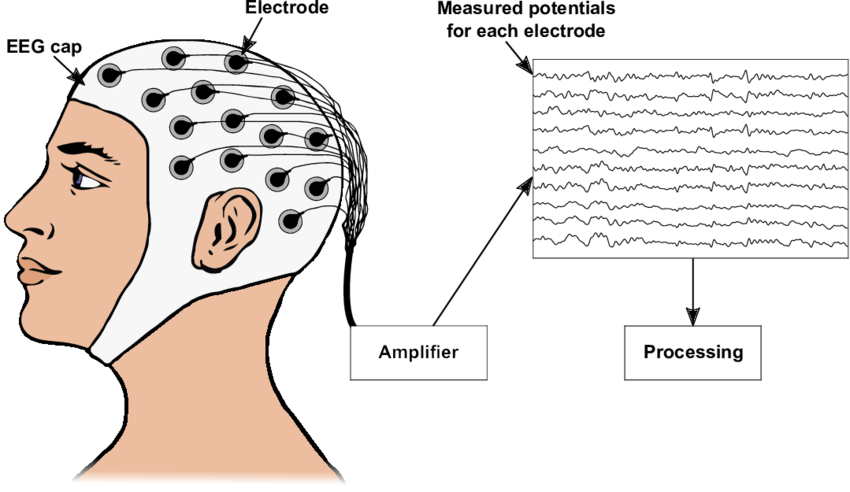
Also, this image is a bit misleading because we don’t usually use caps like that, instead we’ll stick each of the wires on individually with a sticky cream, but in this study, they did actually use a cap.
But, all that being said, this study is still brilliant in what it was able to show. Their EEG’s showed that interactions with dogs, like walking, playing, stroking and grooming affected the brain by:
Increasing general alpha range activity
This is a type of brain activity that’s related to relaxation, emotional stability and has been shown to be associated with states of reduced mental stress
Specifically increasing alpha activity in the frontal and prefrontal lobes
These are parts of the brain with things like movement, higher cognitive function, and behavioural and emotional judgement
Beta range activity increased during certain interactions
This type of activity is thought to be linked to emotional states like heightened concentration
What they used these findings to fundamentally suggest is that:
“…specific dog activities could activate stronger relaxation, emotional stability, attention, concentration, and creativity by facilitating increased brain activity. In addition, interactions with dogs could decrease stress and induce positive emotional responses.”
They also backed up their EEG findings by using a subjective emotional assessment of the people in the study by asking them how they felt before and after interacting with the dogs. All of them said they felt better afterwards but with quite a small sample size which was very specific to one group of people in one area of the world I always take the validity of these sorts of assessments with a pinch of salt.
But I can’t say I don’t agree with what they’re saying.
But having said that, there are lots of other studies which look at the hormonal effects of animal interactions, which showed that when we spend time with animals our cortisol levels - an innate hormone linked to chronic stress - reduce and oxytocin increases - the hormone anecdotally referred to as the ‘love’ hormone produced when we are bonding and connecting with those we are closest with. This also goes some way in explaining why it is that we become so emotionally connected to our animals; because they are quite literally affecting the way our bodies are behaving in the same ways that our closest loved ones do.
So, all in all, this study isn’t really that surprising given the fact that most people would already be able to tell you that they know they feel most relaxed and, hopefully, happiest when around their pets. But the Neuro-nerd in me loves seeing EEG, a tool I use day-to-day at work, help promote new findings in the field of Neuroscience research.
But the long shot of this post is to highlight the invaluable role our pets play in our lives, often in ways that we aren’t even aware of, and how lucky we are to have them around us.
Even if he did steal my birthday cake.
See you next week,
Joe